DirectionR&D as a service

    R&D for systems where devices, signals and cryptography meet

    A research and engineering team for ventures and product companies that build on radio signals, embedded hardware, cryptography and blockchains.
    Short answer

    R&D as a service means our team owns the research and the engineering of your system. We write each unknown as a question with an acceptance plan, test it in our own hardware lab or in code, and build on the options that pass. Work runs in two-week sprints with acceptance criteria you sign, and the results, code and documents are yours.

    Start with a feasibility study
    At a glance
    FieldsSignals · Embedded · Cryptography · Blockchain
    Starta feasibility study or a call
    Processtwo-week sprints, acceptance criteria you sign
    PriceFixed price per written scope
    You ownresults, code, documents

    Fit

    When R&D fits

    Use it when you

    • have a product that depends on something nobody has proved yet: ranging accuracy, proof cost, resistance to an attack
    • need hardware, firmware, cryptography and chain engineers who work as one team
    • must show evidence to investors or a board before the next round of spending
    • want one team to carry the work from the lab test to the running system

    Skip it when

    You already know what to build and need engineers on your roadmap: see Dedicated engineers.

    Fields

    Four fields

    F01

    Signals

    Which radio gives the accuracy your product needs, and how each unit behaves. Wi-Fi FTM/RTT, Wi-Fi CSI, UWB, BLE, LTE and mmWave radar, each tested against a written acceptance plan; pose and activity models trained on mmWave point clouds.

    Signals and sensing →

    F02

    Embedded

    Rust firmware for ESP32-C6 with live tuning, per-device calibration and over-the-air updates; GPU image processing for instruments.

    Embedded and firmware →

    F03

    Cryptography

    Signed multi-party proofs with witness quorums, Ed25519 on every message, zero-knowledge proof systems, and a threat model written before the code.

    Zero-knowledge proofs →

    F04

    Blockchain

    Chain choice across candidates, private proof-of-stake networks, token design with staking, slashing and reputation, and a deterministic reward engine.

    Blockchain engineering →

    How it runs

    From open question to working system

    Your pathEach step is accepted in writing
    1. 01Questionthe unknowns · written downaccepted whenthe unknowns are written as questions you agree with
    2. 02Acceptance planhow each option · is measuredaccepted whenyou sign how each option will be measured
    3. 03Lab test or prototypehardware lab · or codeaccepted whenevery option has a result against the plan
    4. 04Decisiongo, change · or stopaccepted whenyou have a written recommendation: go, change or stop
    5. 05Buildtwo-week sprints · signed criteriaaccepted whenthe sprint criteria you signed pass

    Formats

    Three ways to start

    S01

    Feasibility study

    One fixed question, answered in writing: go, change or stop, with the options tested and the risks.

    Feasibility study →

    S02

    Proof of concept

    A working prototype that proves the one thing your product depends on, measured against the acceptance plan.

    Proof of concept →

    S03

    R&D team on your product

    Our team runs research and engineering in two-week sprints until the system works end to end.

    Proof

    Research and engineering we have done

    All work
    System · Devices

    Devices that prove where they are

    Problem
    Signed proof of physical presence that nobody can fake.
    Built
    Rust firmware on ESP32-C6, radio lab research, signed proofs.
    RustESP32-C6Embedded firmwareWi-Fi FTM
    Firmware to chain, signed off sprint by sprint.
    MVP · Location proof

    Proof of location, built on sensor fusion

    Problem
    Prove where a device is without trusting the device.
    Built
    Signal-harvesting mobile apps, token contracts, Java back end.
    Proof of locationSensor fusionEthereumEOS
    MVP and token contracts that reward confirming nodes.
    Study and prototype

    Proof of humanity with zero-knowledge proofs

    Problem
    Bots drained airdrops and DAO votes; KYC was not an option.
    Built
    A feasibility assessment, then a proof-of-concept prototype.
    Scale
    Six trust levels, L0 to L5
    Zero-knowledge proofsProof of conceptGroth16Halo2
    Working prototype; protocol split into MVP and ZK phases.
    Discovery · Messaging

    Private messenger with zero-knowledge sign-in

    Problem
    No one, not even the operator, may see who talks to whom.
    Built
    Discovery: seed-phrase identity, E2E encryption, ZK sign-in.
    Zero-knowledge proofsEnd-to-end encryptionSignal ProtocolMetadata encryption
    Version 1.0 scope, architecture and team plan, ready to build.
    Feasibility phase · Banking

    Bank-backed stablecoin layer, with Visa

    Problem
    A Visa partner bank wanted crypto inside its own products.
    Built
    Business case review and a stablecoin design on AssetBridge.
    VisaStablecoinCBDCBank-issued stablecoin
    Phase 1 accepted; phase 2 approved, pending regulator.
    Instrument software

    Faster imaging for a microscope maker

    Problem
    Faster cameras outpaced the scanning and image pipeline.
    Built
    Scanning on the move, multithreaded processing, CUDA.
    C++CUDAGPUMachine learning
    Faster super-resolution imaging at the same optical quality.
    SDKs · Layer 2

    zkSync SDKs in five languages

    Problem
    Every integrator needed an SDK in the language it uses.
    Built
    Go, Python, Rust, Android and iOS SDKs, built and maintained.
    zkSyncEthereum layer 2SDKGo
    zkSync docs credit Vareger as the SDK author.

    FAQ

    Questions buyers ask

    Q01What is R&D as a service?

    R&D as a service means our team owns the research and the engineering of your system. We write each unknown as a question with an acceptance plan, test it in our own hardware lab or in code, and build on the options that pass. Work runs in two-week sprints with acceptance criteria you sign, and the results, code and documents are yours.

    Q02What do we get from a feasibility study?

    A written answer to one question: go, change or stop. It lists the options we tested, the result of each against the acceptance plan, and the risks.

    Q03What if the answer is no?

    Then the study did its job before you paid for a build. You keep the evidence and the options that remain.

    Q04Who owns the results?

    You do. Results, code and documents go to your repositories.

    Q05Do you publish results from our work?

    No. We publish nothing from client research, and we name a client only where the client agreed.

    Q06Do you have your own lab?

    Yes. We test radios and sensors in our own hardware lab, each against a written acceptance plan.

    Q07How is this different from dedicated engineers?

    Dedicated engineers join a roadmap you already have. R&D starts earlier, when it is not yet clear what can be built or how.

    Q08How is R&D priced?

    Studies and prototypes have a fixed price per written scope. Ongoing R&D is paid on accepted milestones.

    Next step

    Book a call with Mykhailo and an architect

    A 30 minute call with Mykhailo. You leave with a clear view of scope, risks and next step.

    Mykhailo Tiutin

    CTO, Vareger
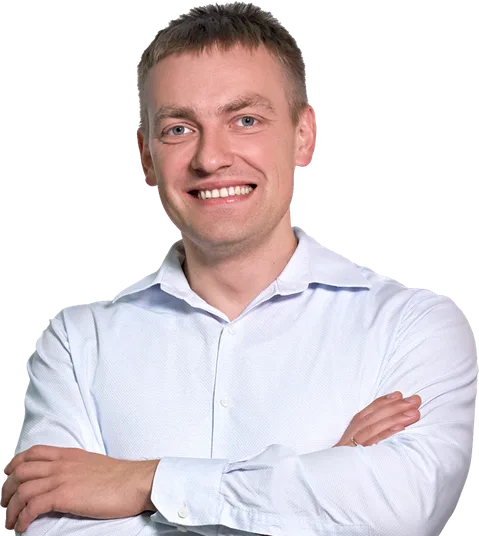
    Mykhailo Tiutin, CTO, Vareger